

 October 12, 2026
 By - admin
 0 comments
 26 views
Mahadasha and Antardasha in Vedic Astrology: A Practical Guide to Planetary Periods
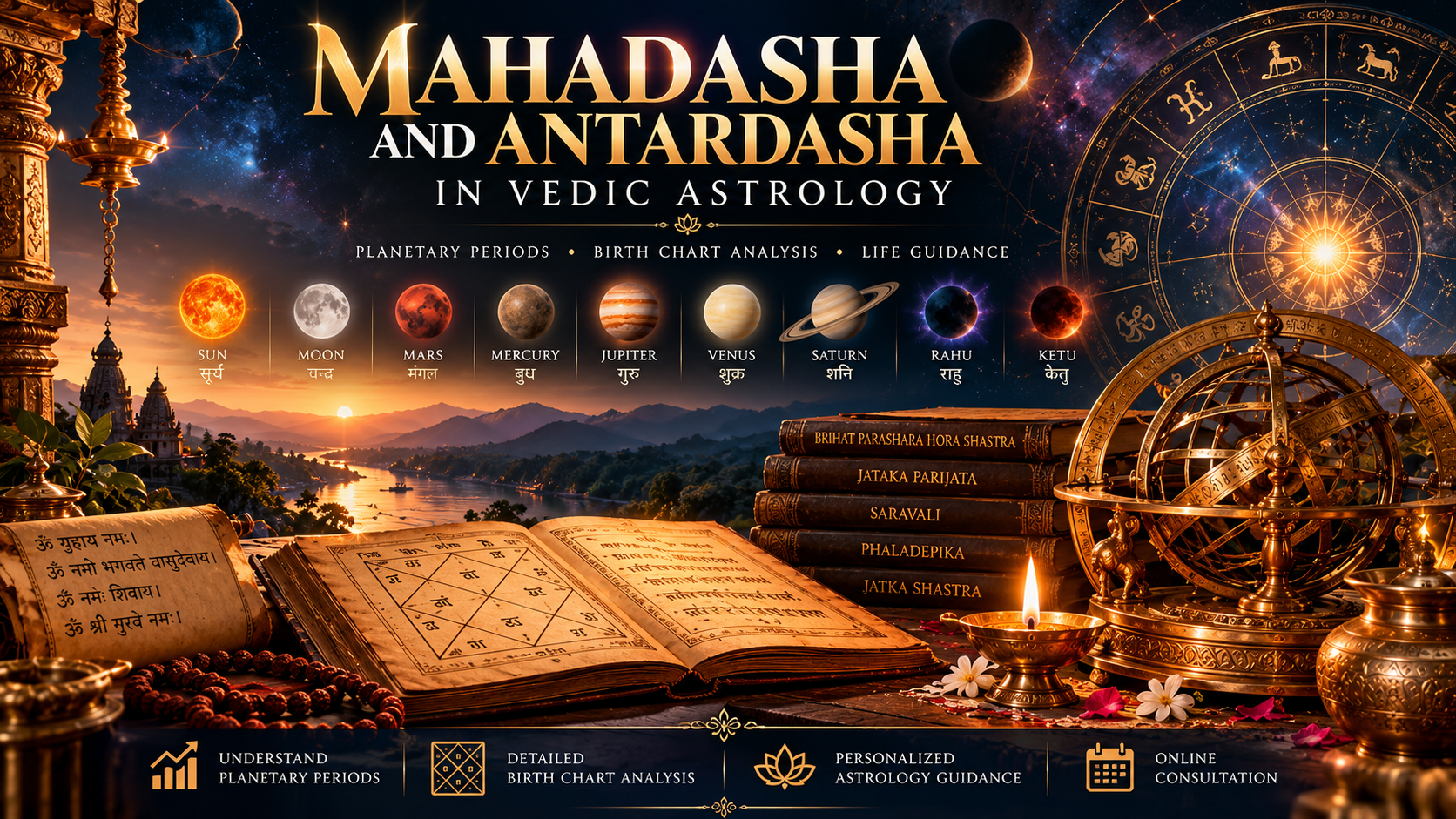
Mahadasha and Antardasha are two levels of planetary time periods used in Vedic astrology. A Mahadasha is the longer, overarching period associated with one graha, while an Antardasha is a shorter period operating within it. In the widely used Vimshottari Dasha system, nine traditional planetary rulers take turns across a symbolic 120-year cycle. Astrologers use these periods alongside a birth chart to discuss themes, timing and changes in emphasis. They do not establish that a particular event must occur.
If you have heard phrases such as “Saturn Mahadasha,” “Jupiter Antardasha” or “running dasha” during a Kundli reading, the terminology can sound intimidating. This guide explains the method in straightforward language, what information a calculation depends on, how traditional interpretations are approached and how to prepare useful questions for an online astrology consultation.
What Is a Dasha in Vedic Astrology?
The Sanskrit term dasha refers to a period or condition. In Jyotisha, several systems organize a birth chart into sequences of planetary periods. The best-known is Vimshottari Dasha, whose complete sequence spans 120 nominal years. This is an astrological framework, not a claim that every person will live for 120 years.
Unlike a general Sun-sign horoscope, a dasha schedule is calculated from individual birth information. In the standard Vimshottari approach, the Moon’s placement in a nakshatra—one of the traditional lunar mansion divisions—determines the planetary ruler active at birth. The portion of that nakshatra remaining determines how much of its first major period is left.
The resulting timeline can be used as a structure for interpreting a horoscope. However, astrology is a traditional interpretive discipline, not a scientifically validated method for predicting jobs, illness, wealth or relationship outcomes. Any reading should distinguish symbolic interpretation from facts that need evidence.
Mahadasha Meaning: The Larger Chapter
A Mahadasha is the major period associated with one of the nine grahas in the Vimshottari system. Its length depends on the ruler. For instance, the traditional Saturn period lasts 19 years, while the Sun period lasts six. Each is interpreted in relation to the person’s natal chart rather than through a single universal description.
A useful analogy is to think of a Mahadasha as a chapter in a long book. The chapter title suggests a theme, but it does not tell you every event, decision or experience within it. Two people running the same planetary period may have very different lives, responsibilities and opportunities. Their circumstances cannot be reduced to a planetary label.
In traditional practice, an astrologer looks at where the dasha ruler appears in the horoscope, the houses it is associated with, its relationships with other chart factors, and the question the client is asking. A period should therefore never be described as automatically lucky, unlucky or dangerous simply because a familiar planet is involved.
Antardasha Meaning: The Shorter Period Inside It
An Antardasha, sometimes called Bhukti, is a sub-period within a Mahadasha. Each major period is divided into nine Antardashas, so the same larger chapter can contain several different interpretive emphases. The sub-periods follow the same order of traditional rulers and last different lengths.
For example, someone may be in Saturn Mahadasha and Venus Antardasha. This does not mean Saturn and Venus are physically exerting a demonstrated force on their life. It means the reader combines two layers of astrological symbolism: the context of Saturn’s major period and Venus’s sub-period as interpreted through that individual’s chart.
Some systems divide time further into Pratyantardasha and additional levels. More divisions produce a finer schedule on paper, but mathematical detail should not be confused with proven predictive precision. A well-framed consultation explains uncertainty, especially when the recorded birth time is approximate.
Mahadasha vs Antardasha: The Difference at a Glance
| Aspect | Mahadasha | Antardasha |
|---|---|---|
| Meaning | Major planetary period | Sub-period within a major period |
| Traditional role | Broad interpretive chapter | More specific emphasis within that chapter |
| Typical duration | Several years, according to ruler | A fraction of the parent Mahadasha |
| Calculation | Based on Vimshottari order and birth nakshatra | Divides the active Mahadasha proportionately |
| Best use in a reading | Discussing longer-term themes | Discussing a narrower period and a focused question |
Both layers belong to the same model and must be read in the context of the whole chart. An isolated statement such as “your Rahu Antardasha is bad” leaves out too much information to be useful.
The Nine Planetary Periods in Vimshottari Dasha
Vimshottari assigns a fixed number of nominal years to nine traditional grahas. Rahu and Ketu are lunar nodes in astronomical terms, although they are treated as grahas in this astrological framework.
| Traditional ruler | Mahadasha length |
|---|---|
| Ketu | 7 years |
| Venus (Shukra) | 20 years |
| Sun (Surya) | 6 years |
| Moon (Chandra) | 10 years |
| Mars (Mangal) | 7 years |
| Rahu | 18 years |
| Jupiter (Guru) | 16 years |
| Saturn (Shani) | 19 years |
| Mercury (Budha) | 17 years |
| Full cycle | 120 years |
The sequence is fixed, but not everyone begins life at Ketu Mahadasha. The starting ruler and the unexpired portion of that period depend on the traditional birth calculation. For a closer look at general chart symbolism, read the site’s guide to the nine planets in astrology.
These numbers describe the traditional calculation system, not evidence that planetary periods produce predictable outcomes. The distinction becomes especially important when advice concerns a costly purchase, a relationship decision or an urgent personal concern.
How Is a Mahadasha Calculated From a Birth Chart?
The starting point is a person’s recorded date, time and location of birth. The standard method calculates the sidereal position of the Moon at that moment, identifies its birth nakshatra and assigns the corresponding ruler. The portion of the nakshatra already traversed is used to estimate the portion of the first Mahadasha that has elapsed.
Later major periods follow the traditional order. Within each Mahadasha, Antardashas are apportioned according to the lengths of the nine rulers. Different software settings, zodiac conventions, calculation assumptions or imperfect source data may produce differing date boundaries. A calculator’s apparently exact timestamp does not remove uncertainty from the birth information.
If the family remembers only “early morning,” do not invent a specific birth time. State the range and its source, such as a hospital record, certificate or family recollection. The consultation preparation guide explains how to organize accurate details without oversharing personal data.
Why Birth Time Accuracy Matters
A birth chart is a calculation based on a particular recorded moment and place. Changing the time can alter ascendant-related factors and, depending on the circumstances, the Moon’s computed position and the starting dasha balance. The practical significance depends on how close the recorded time is to a relevant boundary and on the chosen calculation method.
This does not mean every five-minute difference transforms someone’s future. It means an astrologer should disclose which parts of an interpretation rely on precision that the source information may not support. If you were born abroad, report your birthplace and local time as recorded, not a time converted informally to the country where you currently live.
For international consultations, your present time zone matters for scheduling, while the time and place of birth matter for preparing the chart. Those are two separate pieces of information, and confusing them can lead to administrative or calculation errors.
How Astrologers Interpret Dasha With the Whole Kundli
Traditional interpretation considers more than the name of the active planet. A reader may examine the house placement and sign of the dasha ruler, its role in the natal chart, relationships with other grahas, and relevant divisional-chart practices. Some readers also compare current transits with the active periods.
A single interpretation must still be treated as tentative. A Venus period, for example, is sometimes associated in astrology with relationships, aesthetics or comfort; it does not promise marriage or wealth. A Saturn period is often associated with structure, responsibility or delay; it does not prove misfortune. Such symbols are meaningful within a tradition but are not substitutes for evidence about someone’s actual life.
The most useful question is not “Which planet is making everything go wrong?” It is “What themes does the method suggest, how much does the reading depend on my birth details, and what practical options can I examine independently?” That conversation makes room for personal judgment and avoids fear-based conclusions.
Mahadasha, Career Choices and Professional Transitions
People researching Mahadasha for career growth often have a real decision ahead: changing industries, accepting a promotion, returning to education or starting a business. A traditional reading may discuss planetary periods as a reflective timing framework, but it cannot establish that an offer will arrive, a promotion is guaranteed or a company will succeed.
Use the consultation to clarify questions such as whether you are acting from impatience, how a planned transition fits your responsibilities, and what information is missing. Pair those reflections with market research, qualifications, written contracts, savings and conversations with experienced professionals. If an astrologer mentions a “favourable period,” ask for the traditional reasoning and do not treat it as authorization to neglect practical due diligence.
Someone weighing two job offers, for instance, may benefit more from a written comparison of salary, duties, security and family impact than from one dramatic date. Astrology may form part of their personal reflective process, but the decision and its consequences remain theirs.
Mahadasha, Marriage and Relationship Questions
Another common query is which Mahadasha is good for marriage. Traditional readers may consider different combinations when discussing relationship themes, but there is no universal planetary period that guarantees a wedding or determines whether two people belong together.
Relationships involve consent, communication, compatibility in daily life, expectations and circumstances. If a person is contemplating engagement or a difficult reconciliation, the relevant practical questions concern mutual willingness, safety, shared values and honest dialogue. A chart should never be presented as permission to pressure another person into marriage or continued contact.
When discussing compatibility, make it clear whether the method is examining one birth chart or two, whether the other individual’s information was provided appropriately, and what limitations remain. The purpose should be informed reflection, not certainty about somebody else’s thoughts.
What If a Dasha Is Described as Difficult?
Terms such as “challenging dasha” can create unnecessary fear, especially when a person is already under stress. A label does not establish a hidden threat, a curse, impending illness or a need for an urgent paid remedy. It is reasonable to ask what the phrase means within the astrological method and whether there are other interpretations.
Practical difficulties deserve practical responses. Persistent symptoms require medical attention; intimidation or violence requires safety support; financial problems may require budgeting or regulated advice. A spiritual practice may be personally meaningful, but it should not replace a doctor, licensed counsellor, lawyer or financial professional.
Be cautious of anyone who promises that an additional ritual will definitely reverse a planetary period, guarantees that a partner will return, or demands immediate payment to avoid disaster. A responsible consultation respects your ability to consider options without pressure.
Online Dasha Analysis: What to Ask During a Consultation
A focused online Vedic astrology consultation can be used to understand the terminology on an existing chart or to discuss questions about a period that someone has mentioned. Before booking, write down your main question, identify what you already know, and decide what would make the session useful.
Helpful questions include: Which dasha system is being used? What are the starting assumptions? Does the interpretation depend heavily on an uncertain birth time? Which chart factors support the explanation? Can another traditional interpretation also fit? What action, if any, is within my control regardless of the forecast?
If your concern spans marriage, career and family, consider whether a broader personal astrology consultation is more appropriate than asking for a long list of unrelated event dates. Confirm the current session scope, format and any deliverable on the official website before payment.
Booking an Astrology Consultation With Ayush Rudhra Ji
Astro Ayush Rudhra presents Guruji Ayush Rudhra Ji as a practitioner offering private astrology guidance. Readers who want to ask how Mahadasha and Antardasha fit within a personal Kundli can review the official astrology appointment options. Availability, fees, eligibility and consultation formats should always be checked on the current page, rather than assumed from an older article.
The official contact number currently shown on the website is +91 8960093488. You can use the verified WhatsApp enquiry link to request information about the appropriate consultation type, or visit the contact page. An enquiry does not automatically reserve a slot. Do not send banking passwords, one-time codes or unnecessary identity documents.
For readers in the UAE, UK, USA, Canada, Australia or elsewhere, online appointments avoid assuming that a local physical office exists. Include your current country and time zone when asking about scheduling; provide birthplace details separately if they are relevant to the selected chart service.
Frequently Asked Questions About Mahadasha and Antardasha
Is Mahadasha the same as Antardasha?
No. Mahadasha is the main planetary period; Antardasha is a sub-period within it. In the Vimshottari model, the shorter period adds another layer to the interpretation of the longer one.
How many Mahadashas are there?
The standard Vimshottari cycle uses nine traditional graha rulers. Together their assigned periods total 120 nominal years. A person’s first running period depends on the traditional calculation from their birth nakshatra.
Does every person experience the same Mahadasha at the same age?
No. People are born at different points in the fixed sequence and with different balances of the opening major period. Even people in the same dasha can face different real-life circumstances and interpretive chart conditions.
Can Antardasha predict the exact date of marriage or promotion?
It is used for timing interpretations within the astrological tradition, but it cannot reliably guarantee a real-world event or an exact date. Practical circumstances, personal agency and uncertainty remain important.
What if I do not know my birth time?
Tell the consultant what you know and where the information came from. Ask which calculations remain possible and where uncertainty limits the interpretation. Avoid presenting a guessed time as an official record.
Is Saturn Mahadasha always negative?
No. Traditional astrologers interpret Saturn in the context of the complete birth chart. More importantly, a planetary label should not be treated as proof of misfortune or as justification for a fear-based purchase.
Are Rahu and Ketu actual planets?
Astronomically, Rahu and Ketu correspond to the Moon’s orbital nodes, not physical planets. They are treated as grahas in the traditional Vedic astrology system used for the dasha sequence.
How can I book a private birth chart consultation?
Visit the Astro Ayush Rudhra official booking page, review the current plan details and confirm your slot through the official process. For an administrative enquiry, use +91 8960093488.
Use Planetary Periods for Understanding, Not Fear
Mahadasha and Antardasha give Vedic astrologers a structured language for discussing the passage of time within a birth chart. Understanding the distinction is useful even if you never book a reading: a major period is the larger chapter, a sub-period is a shorter section, and both must be interpreted with care.
If you seek personal guidance, come with accurate information, a focused question and realistic expectations. Ask for explanations, understand where uncertainty remains and make important decisions using practical evidence alongside your own beliefs. For a private enquiry about your Kundli, review Astro Ayush Rudhra’s consultation options or contact the official team at +91 8960093488.
🔮 Book Your Personal Astrology Consultation
Get personalised astrology guidance for marriage issues, business struggles, legal disputes, emotional stress, health concerns, relationship conflict or life direction — based on your unique horoscope.
⏳ Limited slots — confirmation after payment.
Continue Reading
- Online Kundli Reading for NRIs: Birth Details, Time Zones and Personal Astrology Guidance
- Online Astrologer in Dubai for Personal, Career and Relationship Guidance
- Best Astrologer in Australia for Private Online Astrology Consultation
- Business Astrology Dubai UAE for Financial Direction and Growth Timing
Related Articles

Online Kundli Reading for NRIs: Birth Details, Time Zones and Personal Astrology Guidance
Living outside India can make a familiar Indian astrology practice feel surprisingly complicated. You might have your date…

Best Astrologer in Australia for Private Online Astrology Consultation
When life becomes uncertain, people often look for guidance that is private, thoughtful and rooted in deeper understanding.…

Business Astrology Dubai UAE for Financial Direction and Growth Timing
Business decisions in Dubai UAE often move fast. Entrepreneurs, investors, consultants, family business owners, startup founders, traders, real…
Frequently Asked Questions
Astrology can help identify emotional patterns, timing cycles, compatibility themes and practical next steps for love, marriage and relationship understanding.
Yes. Astrology is often used to understand favorable periods for marriage planning, family harmony, emotional healing and major life decisions.
Yes. Personal astrology consultation can be booked online for guidance related to marriage, relationships, business, legal matters, health concerns and life direction.


 15 Oct 2026